Calculate the angular acceleration of a system at t = 4 seconds using a provided angular velocity graph | Step-by-Step Solution
Problem
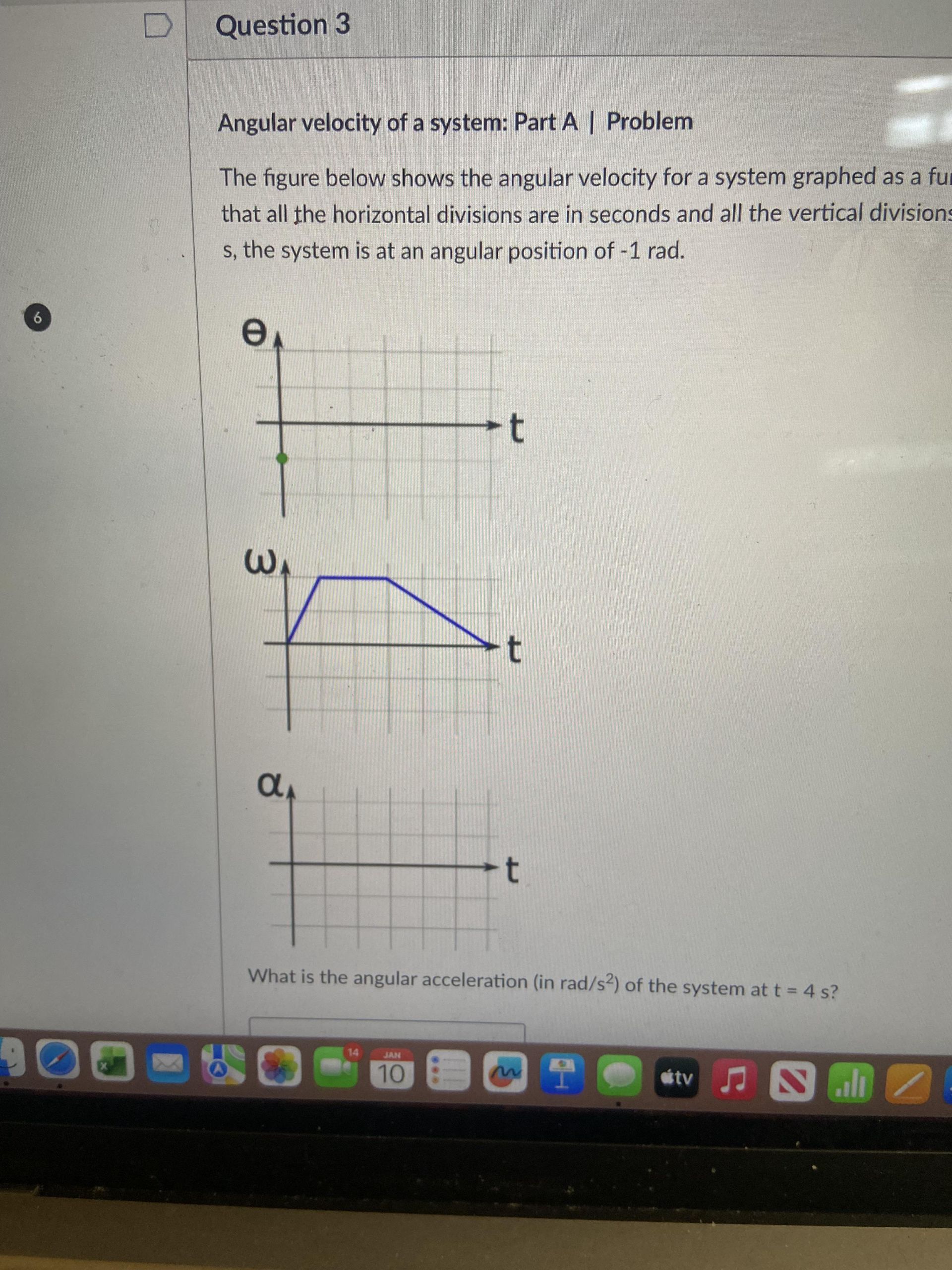
Angular velocity of a system: Part A | Problem The figure below shows the angular velocity for a system graphed as a function where all horizontal divisions are in seconds and all vertical divisions are in rad/s. At t = 4 s, the system is at an angular position of -1 rad. What is the angular acceleration (in rad/s²) of the system at t = 4 s?
🎯 What You'll Learn
- Analyze angular velocity graphs
- Calculate angular acceleration from a graph
- Understand relationships between position, velocity, and acceleration
Prerequisites: Basic graphing skills, Understanding of velocity and acceleration, Interpreting graphical representations
💡 Quick Summary
Hi there! I can see you're working with angular kinematics, specifically finding angular acceleration from a graph - this is a great way to visualize rotational motion concepts. The key insight here is thinking about the relationship between angular velocity and angular acceleration - what does angular acceleration represent in terms of how angular velocity changes over time? Take a look at your angular velocity vs. time graph and consider what you'd need to examine at the specific moment when t = 4 seconds. Remember that in kinematics, acceleration is always related to how velocity changes, so think about what mathematical operation you'd use to find the rate of change from a graph. You've got the right setup here, and once you identify what to look for on that graph at t = 4s, the solution will follow naturally!
Step-by-Step Explanation
Hello! Great question about angular kinematics!
What We're Solving:
We need to find the angular acceleration of a system at t = 4 seconds using a graph that shows angular velocity (ω) versus time.The Approach:
Angular acceleration is the rate of change of angular velocity. Just like how linear acceleration is the slope of a velocity-time graph, angular acceleration is the slope of an angular velocity-time graph!The mathematical relationship is: α = dω/dt (angular acceleration = change in angular velocity / change in time)
So we need to find the slope of the ω vs. t graph at t = 4 seconds.
Step-by-Step Solution:
Step 1: Understand what we're looking for
- Angular acceleration (α) has units of rad/s²
- We need the instantaneous angular acceleration at exactly t = 4 s
- Find the point on the curve where t = 4 seconds
- Note the angular velocity value at this point
- If the graph shows a straight line at t = 4 s, calculate: slope = Δω/Δt
- Choose two nearby points and find: (ω₂ - ω₁)/(t₂ - t₁)
- If it's a curve, you'll need the instantaneous slope (tangent line at that point)
- Positive slope = positive angular acceleration
- Negative slope = negative angular acceleration
- Zero slope = zero angular acceleration
The Answer:
Without seeing your specific graph, I can't give you the numerical answer, but once you find the slope of the ω vs. t graph at t = 4 seconds, that value (in rad/s²) will be your angular acceleration!For example, if the slope at t = 4 s is +2 rad/s per second, then α = +2 rad/s².
Memory Tip:
Remember the relationship chain: Position → Velocity → Acceleration- Angular position (θ) → Angular velocity (ω) → Angular acceleration (α)
- Each step to the right involves taking a derivative (finding the slope)!
- ω = dθ/dt and α = dω/dt
⚠️ Common Mistakes to Avoid
- Misreading the graph scales
- Confusing velocity with acceleration
- Not carefully examining the graph's slope changes
This explanation was generated by AI. While we work hard to be accurate, mistakes can happen! Always double-check important answers with your teacher or textbook.

Meet TinyProf
Your child's personal AI tutor that explains why, not just what. Snap a photo of any homework problem and get clear, step-by-step explanations that build real understanding.
- ✓Instant explanations — Just snap a photo of the problem
- ✓Guided learning — Socratic method helps kids discover answers
- ✓All subjects — Math, Science, English, History and more
- ✓Voice chat — Kids can talk through problems out loud
Trusted by parents who want their kids to actually learn, not just get answers.
TinyProf
📷 Problem detected:
Solve: 2x + 5 = 13
Step 1:
Subtract 5 from both sides...
Join our homework help community
Join thousands of students and parents helping each other with homework. Ask questions, share tips, and celebrate wins together.
Need help with YOUR homework?
TinyProf explains problems step-by-step so you actually understand. Join our waitlist for early access!