Determine the forces and reactions in a statically determinate truss structure with given geometric configuration | Step-by-Step Solution
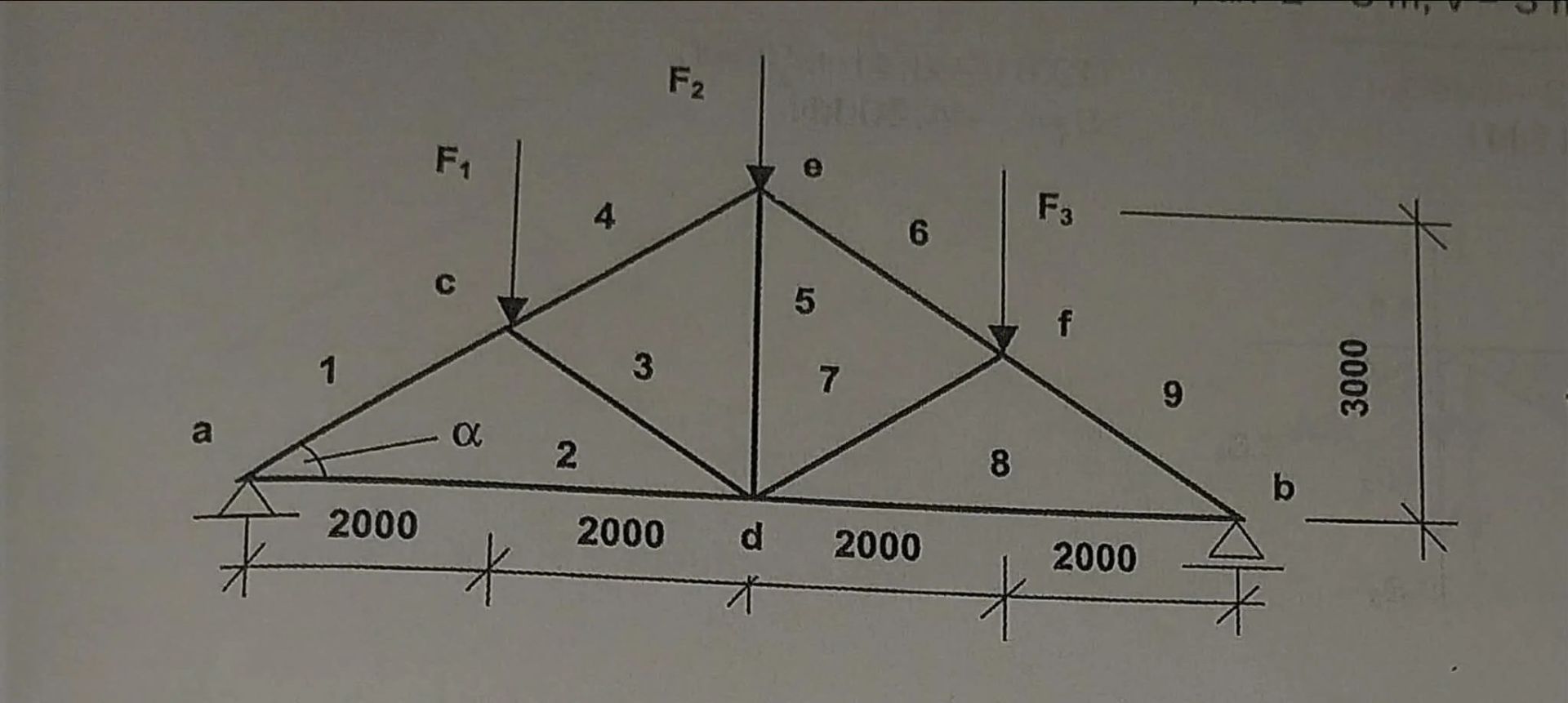
Problem
Truss analysis diagram with forces F1, F2, F3 and members labeled 1-9, with base dimensions of 2000 units
🎯 What You'll Learn
- Calculate internal member forces
- Apply equilibrium equations
- Understand truss load distribution
Prerequisites: Statics principles, Force vector analysis, Free body diagrams
💡 Quick Summary
Hi there! I can see you're working on a truss analysis problem - this is a great example of applying static equilibrium principles to real-world engineering structures. Before diving into calculations, have you identified all the support reactions and thought about which joints might be good starting points for your analysis? The key insight here is that trusses are statically determinate, meaning you can solve them systematically using equilibrium equations (ΣFx = 0, ΣFy = 0) at each joint. I'd suggest starting by finding the support reactions for the entire structure, then looking for joints that have only two unknown member forces - this is where the method of joints really shines! Think about the geometry too - you'll need those member angles to resolve forces into x and y components. Give it a try with this systematic approach, and remember that each solution gives you known values to use at the next joint!
Step-by-Step Explanation
Hello! I'm excited to help you tackle this truss analysis problem! This is a fantastic example of how physics principles apply to real-world engineering structures.
What We're Solving:
We need to analyze a truss structure to find the internal forces in each member (tension or compression) and the reaction forces at the supports. This involves applying equilibrium principles to determine how loads are distributed through the connected framework.The Approach:
A truss is like a skeleton - each "bone" (member) either pushes or pulls to keep the whole structure stable. We'll use three key physics principles:- Static equilibrium: All forces must balance (ΣF = 0)
- Method of joints: Analyze forces at each connection point
- Method of sections: Cut through the truss to analyze internal forces
Step-by-Step Solution:
Step 1: Set up your coordinate system and identify knowns
- Establish x and y axes
- Note the given dimensions (2000 units for base)
- Identify applied forces F1, F2, F3 and their locations
- Count members (1-9) and joints
- Apply equilibrium to the entire truss: ΣFx = 0, ΣFy = 0, ΣM = 0
- This gives you the reaction forces at the supports
- Why this works: The whole truss must be in equilibrium before we look at individual parts
- Calculate angles for each member using trigonometry
- Find the length of each member
- This is crucial: Forces act along member directions, so we need these angles!
- Start at a joint with only 2 unknown forces
- Write equilibrium equations: ΣFx = 0 and ΣFy = 0
- Solve for the two unknown member forces
- Move to the next joint with only 2 unknowns
- The beauty: Each solution gives you known values for the next joint!
- Check that forces at the final joint also satisfy equilibrium
- Ensure your answer makes physical sense (compression where expected, etc.)
The Answer:
Since I can't see the specific values of F1, F2, and F3 in your diagram, I can't give you the numerical results. However, your final answer should include:- Reaction forces at supports (magnitude and direction)
- Force in each member 1-9 (magnitude and whether it's tension "T" or compression "C")
- A clear force diagram showing your results
Memory Tip:
Remember "Joint by Joint, Two by Two" - always move to joints where you have only 2 unknown forces. If you get stuck, try the method of sections to "cut" through problematic areas and solve for forces directly!Keep going - truss analysis is like solving a puzzle where physics provides all the clues! You've got this! 🏗️
⚠️ Common Mistakes to Avoid
- Incorrect sign conventions for forces
- Misinterpreting joint equilibrium conditions
- Computational errors in force calculations
This explanation was generated by AI. While we work hard to be accurate, mistakes can happen! Always double-check important answers with your teacher or textbook.

Meet TinyProf
Your child's personal AI tutor that explains why, not just what. Snap a photo of any homework problem and get clear, step-by-step explanations that build real understanding.
- ✓Instant explanations — Just snap a photo of the problem
- ✓Guided learning — Socratic method helps kids discover answers
- ✓All subjects — Math, Science, English, History and more
- ✓Voice chat — Kids can talk through problems out loud
Trusted by parents who want their kids to actually learn, not just get answers.
TinyProf
📷 Problem detected:
Solve: 2x + 5 = 13
Step 1:
Subtract 5 from both sides...
Join our homework help community
Join thousands of students and parents helping each other with homework. Ask questions, share tips, and celebrate wins together.
Need help with YOUR homework?
TinyProf explains problems step-by-step so you actually understand. Join our waitlist for early access!